
A founder texted me last month. Just four words: "We fucked up bad."
I love these messages. Not because I'm some sadistic consultant who feeds on the pain of others (ok, maybe a little), but because it usually means something interesting happened. And interesting means I get to learn something.
His company — let's call it TechCo because I do sign these things called NDAs and don't enjoy hiring lawyers — had just launched an empowerment initiative. One of those things that's supposed to make all the staff happy, unlock productivity, stop the endless approval chains. The kind of initiative that looks great in the all-hands slide deck.
Instead? Twelve people quit. Twelve mostly senior people. In four months.
These weren't "moved on to pursue other opportunities" resignations. They were rage-quits. Two didn't even give notice. I heard one literally sent a Slack message that said "I'm out" and changed their status to a middle finger emoji.
I asked him what happened. The gist: "We gave them what they wanted. We empowered them. And they all left. What the hell?"
I had him send me any recent internal survey data, their OKR docs, their org chart, and — this is the important bit — asked both leadership AND a random sample of employees to rate where they thought the company was on a bunch of behavioural dimensions (a thing I've cobbled together over the years and call Faultline).
What came back nearly made me spit out my coffee.
Leadership thought things were way too centralised and wanted a big empowerment push, give teams more autonomy. Staff thought they already had a good taste of autonomy and were keen to pretty much maintain that status-quo.
So, when the 'empowerment initiatives' rolled out, staff experienced it as MORE control, not less. Enforced RACI charts. Personal OKRs. Budget approval thresholds. Team quarterly business reviews. Leadership saw these as mechanisms to formalise the autonomy they were granting. Staff experienced them as new bureaucracy being imposed on the freedom they already had.
Whoopsies.
Both groups wanted the same thing. Faster decisions. More autonomy. Better execution. But they might as well have been working at different companies.
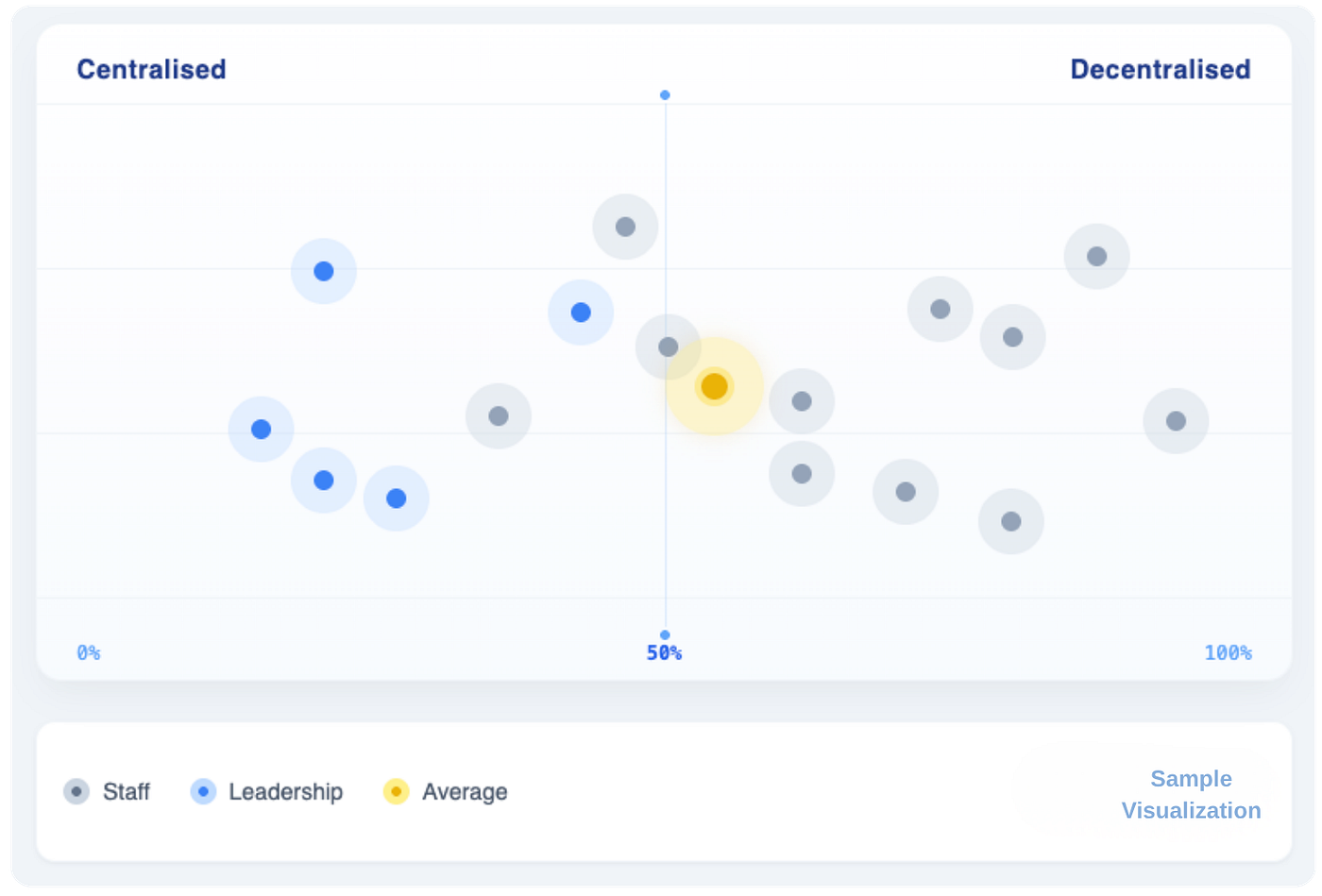
A simulated "Faultline" graph reflecting the situation at "TechCo" | Image credit: Author
I placed the cost of this little reality gap at somewhere near $1 million in replacement expenses and lost productivity. (And that's just the stuff you can measure. The cost to morale, to the people who stayed, to the anonymous Glassdoor reviews of "don't work there"? That's probably double.)
This isn't some isolated incident. It's happening at 44% of scaling companies right now¹. And the peak danger zone? Companies between 50 and 150 employees. That messy middle where 65% of scale-up failures originate². Where culture goes from "we all know how things work here" to "wait, what the hell is going on?"
Why Your Strategic Offsite Didn't Actually Work
You did the strategic planning offsite. Probably somewhere with a view. Definitely with a whiteboard. I bet some muffins were close by. You crafted your vision, your mission, your strategic pillars. You cascaded OKRs from the executive team down to individual contributors. You hold all-hands meetings where the CEO repeats the same three priorities. (Sometimes with slight variations to keep it fresh.) You run engagement surveys. You do culture assessments.
Sound familiar?
The data on how well this works is… not great.
Only 28% of executives can list their company's top three strategic priorities³. Let that sink in for a second. These are the people SETTING the priorities, and seven out of ten can't remember what they are.
And staff? Well, don't bother asking them what the company's priorities are. You'll get a shrug, a guess, or a joke. 95% of employees either don't know the strategy or believe there isn't one⁴.
But anyway… Maybe these unflattering stats don't even matter.
Why? Because there's a fatal assumption baked into literally everything companies do about alignment.
Goal alignment is not the same as strategic coherence.
It might sound like semantics. But I reckon it's a distinction that matters and where most leadership teams quietly derail their own strategy.
Goal alignment is agreement on where to go. Future state. Objectives. Targets. The stuff that goes in your OKR doc that nobody reads after week two.
Strategic coherence is shared understanding of where you ARE right now. Current reality. How things actually work. What behaviours you're actually seeing on the ground.
Think about it this way. You can't chart a course to your destination if you disagree about your starting point. If I think we're in Melbourne and you think we're in Brisbane, our directions to Sydney are going to be… different.
Change initiatives fail when they solve problems that don't exist. Or miss the ones that do. And that's exactly what's happening in so many scaling companies I've come across.
So why can't companies see the real problems? Because they're measuring the wrong things.
Traditional measurement tools can make the situation worse, not better.
Engagement surveys measure satisfaction scores. ('Do you like working here? On a scale of 1–10, how likely are you to recommend us?' You know, the stuff people lie about because they're scared their answers aren't actually anonymous.) OKR systems track goal attainment. Culture assessments capture self-reported adherence to values. All useful data points. None of them reveals whether leadership and staff are seeing the same organisational reality.
These tools miss the stuff that actually kills you:
- Perception gaps about how things actually work
- Leaders who fundamentally disagree but play nice in meetings
- Teams quietly pulling in opposite directions
- And my personal favourite: huge pendulum swings, where you ricochet from one extreme to another like a drunk driver changing lanes.
You can't fix what you can't see. And you can't see what you don't measure.
How Smart People End Up Inhabiting Parallel Universes
I've had way too many conversations and spent way too much time thinking about how organisations end up with these reality gaps. I've boiled it down to these three patterns that keep popping up.
Leadership Fragmentation
There's a source of incoherence that will absolutely destroy you. And it happens at the top. (Which is why it's so dangerous — it cascades down and amplifies.)
Leadership team members often perceive fundamentally different current states. But they use the same language, so they think they're aligned.
Picture this. Three executives in a room. They're talking about how much autonomy their staff have. They all nod along. "Yep, we're pretty autonomous." Everyone agrees.
Except one executive thinks autonomous means teams control their own P&L and can fire their manager. Another thinks it means people can work from the coffee shop instead of the office. The third thinks it means people can choose whether to turn their camera on in Zoom calls.
They may have nodded in agreement, assuming consensus. But they're literally describing different organisations. And nobody realises it because they agreed on the words.
(This is like two people agreeing they love 'music' and then one puts on death metal and the other puts on jazz and they're both confused why the other person is unhappy.)
This fragmentation cascades like a shitty game of telephone, except the stakes are millions of dollars and people's livelihoods.
Each leader acts on their perception in their domain. (The CFO gives teams full P&L authority. The COO implements a 'coffice' policy. The CTO sends out guidance on camera-optional meetings.) Their reports get contradictory messages from different executives. Front-line employees experience what I can only describe as a split-personality organisation where the rules change depending on which leader you report to.
Leaders rarely test for shared mental models underneath the words.
Small gaps at the top become massive cracks three levels down. It's absolutely devastating to execution.
Organisational Parallax, or The "Sensemaking" Problem
Back in the 1990s, this organisational theorist named Karl Weick made an observation that kind of broke my brain when I first read it — and still makes it ache even now.
Organisations don't have objective reality. They have enacted reality.
What this means: different people "make sense" of the same events in radically different ways. Your beliefs shape what you see, which reinforces your beliefs in this lovely recursive loop that's more twisted than that Inception movie.
It's the parallax effect — the same phenomenon that makes nearby objects appear in different positions depending on your viewing angle. Look at your thumb with your left eye closed, then your right eye closed. Different position, right? Same thumb, different reality.
The same thing happens in organisations. Let's call it Organisational Parallax because Weick didn't call it that, so I'm claiming it.
Leaders see strategy, vision, market forces. (They're in board meetings, investor calls, looking at competitive landscapes.) Staff see execution, process, customers. (They're in the weeds, dealing with the actual work, talking to actual humans who use the product.) Leaders have board context and investor pressure that staff don't see. Staff have customer pain points and process bottlenecks that leadership doesn't experience.
The same event — let's say a product launch that had some bugs — produces completely different conclusions about "what happened" depending on where you sit. Leadership sees: "We shipped on time, iterated quickly, learned a lot." Staff sees: "We launched broken shit because leadership wouldn't let us delay, and now we're firefighting instead of building new features."
Both are kind of true. Both are kind of false. Both become THE truth for their respective groups.
Now, this is where the 50–150 employee range becomes the danger zone.
Because at fewer than 50 people you maintain shared context through osmosis. Everyone sits in the same room, overhears the same conversations, participates in the same debates, complains about the same stuff. You can't help but stay aligned because proximity forces constant calibration.
Between 50 and 150 employees? Osmosis dies. You're too big for it. (People are in different offices, different floors, different Slack channels they're not invited to.) But you're too early for formal systems. (You don't have proper documentation, your onboarding is "shadow someone for a week," your decision-making process is "whoever is loudest in the room wins.")
This is where divergence explodes. Leadership operates from one set of assumptions about "how things work here" while different pockets of the organisation develop their own local realities. Engineering thinks you're a chaos factory. Sales thinks you're too slow. Product thinks you're political.
By 150 employees, most companies start frantically building systems — documentation, processes, communication structures, all the grown-up stuff. Which is great… unless those systems codify a reality that only exists in leadership's perception. Then you're kind of just documenting and enforcing a fiction.
When Both Sides Are Right (And That's The Problem)
Management researchers Wendy Smith and Marianne Lewis spent literal decades studying a phenomenon that drives executives crazy: organisational paradoxes. These are persistent tensions between opposing forces that can't be resolved, only managed.
Classic either-or thinking that dominates business strategy assumes you need to pick a side. Centralised or decentralised. Planning-focused or action-focused. Individual performance or team collaboration.
But Smith and Lewis demonstrated that high-performing organisations don't choose. They calibrate. They maintain productive tension through both-and thinking.
And it's in that detail where coherence breaks down and companies can implode.
Leaders and staff often experience different sides of these paradoxes acutely. Staff feels micromanaged and wants empowerment. Leadership feels chaos and wants accountability. Both perceptions are valid responses to their experienced reality. (This is the annoying part — neither group is delusional. They're both right based on what they're experiencing.)
Conflict emerges when each group tries to "solve" the tension by swinging to opposite extremes.
This creates an overcorrection trap. "Too much chaos! We need more structure!" So they swing heavily from pragmatic execution to attention-to-detail planning. "Let's implement rigorous planning processes! Let's have approval workflows! Let's make sure nothing ships without review!"
This doesn't calibrate — it binary flips. You didn't find the sweet spot. You just traded one set of problems for the mirror-image problems. Micromanagement becomes total autonomy becomes chaos becomes micromanagement again. Rinse and repeat every 18 months like clockwork.
Elite organisations maintain productive tension. They're comfortable being uncomfortable. But — and this is critical — you can't maintain productive tension if you don't agree on where you currently sit on the spectrum.
The Case for Behavioural Measurement
So how the hell do you make the invisible visible?
Well, it's NOT by running tired engagement surveys asking employees to rate abstract values. "Do you feel aligned with our integrity value?" "Do you believe in our mission?" "Would you recommend this as a place to work?"
Self-reported adherence can be meaningless. Ask anyone "Do you have integrity?" and they'll say yes. Even the people who definitely don't. (Especially the people who definitely don't.)
Behaviours work differently.
You can see them happening. They're specific. Comparable. Diagnostic. They reveal more about HOW something exists, not just that it exists.
The spectrum approach I use basically asks, "where are we on a set of behavioural dimensions that matter?" When you do that, you get four things that help cut through any bullshit you might be trying to tell yourself:
- Where we actually are. (Current state, based on observable behaviours)
- Where we want to be. (Desired future state)
- The gap between what leadership and staff perceive. (The reality gap)
- Whether we're trying to move in the same direction or opposite directions. (The crack detector)
The current and future state view together is where it gets really interesting. This is the bit that makes executives' eyes light up because it gives them some objective predictive power instead of just vibes.
Measuring current state reveals perception gaps — do we see the same reality? Measuring the future reveals vision misalignment — do we want the same thing? Comparing both reveals directional conflicts — are we about to crack?
The three-layer diagnostic reveals the full picture:
Layer one: Leadership fragmentation. Do leaders agree on current reality? (Spoiler: usually no.) If leaders disagree, they send conflicting signals to the organisation.
Layer two: Perception gap. Do leadership and staff see the same reality? Large gaps mean decisions get based on false assumptions. (Leadership is solving problems staff doesn't think exist. Staff are fighting problems leadership doesn't think are real.)
Layer three: Directional alignment. Do groups want to move the same direction or opposite directions? Opposing directions predict change resistance. (Like, 90% probability of failure levels of resistance.) Convergent directions predict readiness.
Case Study: Communication Transparency Gap
Ok, enough theory. You get the concepts. But how does this actually play out when the stakes are real and the clock is ticking?
I gave you the quick example earlier — the empowerment disaster that cost $1M. Now let me show you a different pattern in detail.
The Communication Transparency Gap
A 95-person fintech discovered a 40-point transparency gap when I ran the Faultline diagnostic. Leadership rated their communication at 78% transparent. (All-hands meetings! Open door policy! We share everything we can!)
Staff rated communication as leaning more towards a "need-to-know" culture — 38% transparency. (Leadership is secretive. We find out about decisions after they're made. We have no idea what's actually happening.)
The root cause? Leadership couldn't share fundraising struggles because negotiations were commercially sensitive.
Staff interpreted the silence as lack of trust. Or worse — company failure. "They're not telling us about fundraising because we're about to run out of money and they're all interviewing for new jobs," was the gist of the water cooler conversations.
Anxiety spread. Top performers started interviewing elsewhere.
The fix wasn't sharing confidential information. That would've been stupid and possibly illegal.
The fix was transparency about transparency. (Meta, I know.)
Leadership explained: "We're in fundraising conversations right now. We can't share details because it would hurt our negotiating position and cost everyone in this room money in the form of worse terms. We'll share when we have news. Here's what we CAN share about runway and plans."
You could feel the tension ease within a couple of months. Not because practices changed dramatically — they still couldn't share fundraising details — but because perception aligned with reality. Staff understood the constraints.
Context matters.
The Faultline Framework: A Practical Guide
So you're convinced this matters. (Or at least intrigued enough to have read this far.) Now what?
Diagnosing coherence gaps is useful. Actually closing them requires a thought-out process. Here's the framework I use with clients which forms the basis of our Faultline service. You could run a basic version of it yourself following these steps.
Step One: Establish Baseline Reality (The "Oh Shit" Moment)
Select at least 6 behavioural dimensions that matter to your business model. Don't pick random ones. Pick the ones that actually matter to your strategy.
Essential for basically all companies:
- Decision authority (centralised ↔ decentralised)
- Execution orientation (planning-focused ↔ results-focused)
- Communication flow (transparent ↔ need-to-know)
- Innovation orientation (traditional ↔ change-focused)
Then add based on your strategic priorities:
- Scaling operations? Add process rigidity and operational precision
- Market-driven? Add customer-centric vs product-centric
- Knowledge work? Add individual vs team performance
Survey both leadership and at least representative staff — if not your entire staff population. (Not just leadership. That's the whole point.) Rate current state and desired future state on a 0–100 scale with the two behaviours of a spectrum as the anchors at either end.
For example, for decision authority: 0 = centralised, all decisions made by CEO, 100 = decentralised all decisions made by teams.
Make staff responses anonymous to encourage honesty. But keep leadership responses attributed to enable dialogue. (Leadership needs to own their perceptions.)
This is usually where clients have their "oh shit" moment. I've had CEOs go quiet for a full minute staring at the slide. The gaps are almost always bigger than they expected.
Step Two: Analyse Patterns (The "WTF" Moment)
Run the three-layer analysis:
- Calculate leadership fragmentation range. (How spread out are your leaders?)
- Calculate perception gaps between leadership and staff averages. (How far apart are the groups?)
- Compare change vectors to identify convergent, parallel, divergent, or asymmetric movement. (Are you about to crack?)
Identify priority patterns:
- Opposing directional conflicts = highest risk (fix this first)
- Leadership fragmentation above 25 points = you're sending mixed signals (your leaders need to align)
- Current perception gaps above 25 points = you're making decisions based on false assumptions (this is dangerous)
- Overcorrection above 40 points crossing midpoint = pendulum swing incoming (stop before you make it worse)
The actual point thresholds aren't gospel; just rough guardrails. The key is to spot what's clearly out of whack.
Step Three: Generate Hypotheses (The Investigation Phase)
For each high-priority pattern, generate testable hypotheses about root causes. Not conclusions. Hypotheses. Don't jump to solutions yet.
- Why does this pattern exist?
- What organisational history created it?
- What incentives reinforce it?
- What information asymmetry drives the gap?
For example, one of the hypotheses for our transparency vs need-to-know case study earlier was this: "Could be a 'last mile' problem where leadership may believe they're cascading effectively, but staff experience the final delivery as selective filtering by middle management."
Then validate through targeted investigation — and the best way I know how to do this is just through conversations. "Does this sound right to you, is this what you see happening?" I find people generally have a good sense of what's going on… It's just we rarely ever talk honestly about it.
Step Four: Facilitate Dialogue (The Hard Part)
This is where most companies fail. Not because they can't diagnose. Because they can't have that hard conversation.
Giving it some structure helps, so here are four suggested sessions to work through.
Session 1: Share reality. Present data visually without interpretation. Let the patterns speak for themselves. Leaders react authentically. ("Holy shit, I had no idea staff saw it that way.") Frame as learning, not blaming. (If people feel blamed, they get defensive and shut down.)
Session 2: Explore hypotheses. Present your testable hypotheses for each major pattern. Leaders validate or refute based on their experience. Identify which ones to investigate further. (Some will be obviously wrong. Some will be uncomfortably right.)
Session 3: Calibrate targets. For each dimension, debate optimal position. Recognise that paradoxes require calibration, not solving. Different domains may need different calibrations. (Engineering might need different balance than Sales. That's ok.)
Session 4: Create implementation roadmap. Translate targets into specific actions. Identify quick wins versus long-term shifts. Assign owners. Set timelines. Define how to measure progress.
External facilitation helps. Psychological safety is critical. No punishment for honest perception, or people will just tell you what you want to hear. The great thing about the process is that there are no right or wrong answers — one side of a spectrum is not better than another. It's about the understanding of where you sit on the spectrum and how that aligns with the organisation you're trying to be.
Step Five: Implement and Remeasure (The Follow-Through)
This is the critical part that people can muck up easily in the implementation process: Be specific!
As an outcome, don't say "be more empowered." That's meaningless.
Say "these twelve decision types don't require approval anymore." That's specific.
Make shifts observable through actual process and structure changes. Not just magical mindset shifts.
Where you can, pilot with a single team first. Better to break things on a small scale. Don't bet the company on untested changes.
Remeasure at 6–12 months:
- Are changes being noticed? Are they interpreted as intended?
- Are gaps narrowing? Any unintended consequences?
- Has coherence improved? What new patterns emerged?
Alignment is continuous calibration. You need to reassess every 12–18 months or after major changes — funding rounds, leadership hires, market pivots, mergers and acquisitions.
(I know. I know. You wanted this to be a one-and-done thing. It's not. Sorry.)
Seeing the Same Company
Most leadership teams believe their primary challenge is getting everyone aligned on where to go. Vision. Strategy. Goals. OKRs.
The deeper challenge is getting everyone aligned on where you actually are right now.
You can't execute strategy if leadership and staff see different organisational realities. You can't manage paradoxes productively if you don't agree on your current position. You can't change effectively if your diagnosis is based on false assumptions.
The shift companies need to make:
- From strategic alignment (goal agreement) to strategic coherence (reality agreement).
- From values surveys to behavioural measurement.
- From assuming shared understanding to testing for it.
- From solving organisational problems to calibrating organisational paradoxes.
The strategic coherence gap is invisible in daily operations. Which is why it's so dangerous. Leadership and staff interact normally. Meetings happen. Work gets done. Everything looks fine on the surface. The gaps only become painfully obvious when change initiatives fail, top talent walks out the door, or execution grinds to a halt.
For companies in the 50–150 employee range — the messy middle where culture can break and strategic execution fractures — the goal here isn't about avoiding catastrophic failure. (Though honestly, avoiding catastrophic failure is a pretty good goal.)
It's about unlocking the next stage of growth.
Your organisation has coherence gaps. It does. They all do. Even the good ones.
The real question is: Can you see them? And what are you going to do about it?
About the author: Has sat through approximately 847 strategic offsites where everyone nodded in agreement while meaning completely different things. Has been called 'uncomfortably direct' in feedback sessions, which is consultant code for 'tells you things you don't want to hear but probably need to.'
If you're dealing with this right now and want help, check out Faultline: The Leadership Alignment Tool.
References
¹ Lucid. "The Warning Signs and Risks of Poor Organizational Alignment." Lucid Blog, https://lucid.co/blog/warning-signs-and-risks-of-poor-organizational-alignment.
² Noam Wasserman, The Founder's Dilemmas (Harvard Business School).
³ D. Sull, S. Turconi, C. Sull, and J. Yoder, "Turning Strategy Into Results," Sept. 28, 2017, https://sloanreview.mit.edu
⁴ Kaplan, R. S., & Norton, D. P. (2005). Creating the Office of Strategy Management. Harvard Business Press.
Other sources referred to in this piece:
- Weick, K. E. (1995). Sensemaking in Organizations. Sage Publications.
- Smith, W. K., & Lewis, M. W. (2011). "Toward a Theory of Paradox: A Dynamic Equilibrium Model of Organizing." Academy of Management Review.
- Smith, W. K., Lewis, M. W., & Tushman, M. L. (2016). "'Both/And' Leadership." Harvard Business Review.